Retatrutide (LY3437943) is described in published literature as a single synthetic peptide agonist at the GIP, GLP-1 and glucagon receptors. This reference summarizes receptor and molecular research, separates direct evidence from cross-study context, and explains why literature about the compound cannot verify the identity or quality of a commercial lot.
For in-vitro and preclinical laboratory research use only. Not for human or veterinary use. This page is a scientific reference, not medical guidance.
What is retatrutide?
The discovery paper for LY3437943 describes a long-acting triple receptor agonist with activity at the glucagon receptor (GCGR), glucose-dependent insulinotropic polypeptide receptor (GIPR) and glucagon-like peptide-1 receptor (GLP-1R). In the reported in-vitro experiments, the compound showed balanced GCGR and GLP-1R activity with greater GIPR activity.1
- Published name: Retatrutide
- Developmental code: LY3437943
- Receptor systems studied: GIPR, GLP-1R and GCGR
- Research scope: receptor pharmacology, structural biology, preclinical models and registered clinical investigation (e.g., Jastreboff et al., 2023)
Which receptor systems does retatrutide target?
Published receptor assays characterize retatrutide as an agonist at GIPR, GLP-1R and GCGR.1 The three-target description is a pharmacology classification. It does not, by itself, establish the identity, purity, content or suitability of material sold under the same name.
GIP receptor
The GIPR component is one part of the reported multi-receptor profile. Interpret potency values only within the assay, reference ligand and calculation described by the source; ratios from one experiment should not be treated as universal constants for every material or assay.
GLP-1 receptor
The GLP-1R component provides a second receptor pathway in the published profile. A receptor-response result is biological evidence under defined conditions, not an analytical identity test for a supplied lot.
Glucagon receptor
The GCGR component distinguishes the published triple-agonist design from dual GIPR/GLP-1R compounds. Mechanistic interpretation should remain tied to the model and endpoint reported in the cited experiment.
What evidence comes from direct comparison studies?
The 2022 discovery paper includes direct experimental comparisons within its own receptor assays and preclinical models.1 A direct comparison supports conclusions about the stated design, model and endpoint. It does not justify importing numerical differences from separate studies with different methods.
The Retatrutide versus Tirzepatide comparison separates direct comparisons from cross-study context and avoids converting separate experiments into a superiority claim.
What does structural research show?
A 2024 structural study reported receptor-bound structures and functional analyses intended to explain how retatrutide engages GLP-1R, GIPR and GCGR.2 Structural evidence can clarify binding interactions and receptor activation mechanisms; it does not verify the chemical identity of an untested commercial sample.
What evidence comes from clinical research?
Peer-reviewed phase 2 studies have reported results for retatrutide in defined human study populations.34 Those studies establish findings only for the investigated material, protocol, participants and endpoints. PYXAX cites them as literature context and does not translate clinical outcomes into instructions, expected outcomes or suitability claims for research materials.
Study status changes over time. Use the linked ClinicalTrials.gov record for NCT04881760 and the registry search for LY3437943 to check current dates and status rather than relying on a fixed summary here.
What can published research establish about the compound?
Published research can describe the compound definition used by the investigators, receptor assays, structures, models and reported outcomes. The strength of any conclusion depends on the experimental design, controls, method and source.
What should not be inferred about a commercial material?
Scientific literature does not establish that material sold under the name retatrutide has the expected identity, chromatographic purity, content, sterility, endotoxin status or stability. Those are material- and lot-specific questions. A commercial record must connect the sample, lot, method and result without borrowing evidence from a paper.
How is a PYXAX lot evaluated?
Use the COA Library to check the documentation status for the exact listed lot. A published record should be read for compound identity, strength or material description, lot identifier, issuing laboratory, methods and results. A pending status means the documentation is not available and must not be replaced with expected values or literature data.
The COA interpretation guide, HPLC guide and LC-MS guide explain the boundaries of lot-specific analytical evidence.
References
- Coskun T, et al. LY3437943, a novel triple glucagon, GIP, and GLP-1 receptor agonist: from discovery to clinical proof of concept. Cell Metabolism. 2022. DOI: 10.1016/j.cmet.2022.07.013.
- Li Y, et al. Structural insights into the triple agonism at GLP-1R, GIPR and GCGR manifested by retatrutide. Cell Discovery. 2024. DOI: 10.1038/s41421-024-00700-0.
- Jastreboff AM, et al. Triple-Hormone-Receptor Agonist Retatrutide for Obesity — A Phase 2 Trial. New England Journal of Medicine. 2023. DOI: 10.1056/NEJMoa2301972.
- Sanyal AJ, et al. Triple hormone receptor agonist retatrutide for metabolic dysfunction-associated steatotic liver disease: a randomized phase 2a trial. Nature Medicine. 2024. DOI: 10.1038/s41591-024-03018-2.
PYXAX research availability
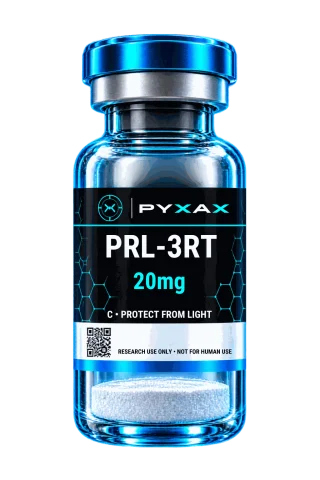
Current catalogue context is available on the PRL-3RT (Retatrutide) product page. Product availability and scientific literature are separate from exact-lot analytical documentation.
Further context: Interpret peptide purity and analytical testing.