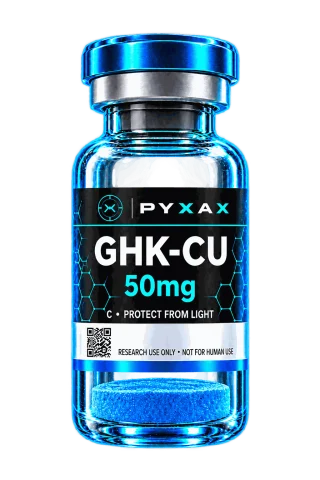
GHK-Cu is the copper(II) complex of the naturally occurring tripeptide glycyl-L-histidyl-L-lysine (GHK). First isolated from human plasma in 1973, it is among the longest-studied peptides in matrix biology, with a preclinical literature spanning five decades of fibroblast, gene-expression, and tissue-remodeling research. That depth of published work — combined with the compound’s distinctive copper chemistry — is exactly why source verification matters: a copper-chelated peptide has a specific, testable identity, and confirming that the copper is correctly coordinated is not something purity numbers alone can establish.
This guide covers the molecular profile of GHK-Cu, the gene-expression and matrix pathways described in the preclinical literature, a survey of published PubMed studies with citation years, common in-vitro research applications, and the documentation a researcher should expect from a research-grade lot.
For in-vitro and preclinical laboratory research use only. Not for human consumption.
Section 1 — Molecular Profile
- Compound name: GHK-Cu (Copper tripeptide-1; glycyl-L-histidyl-L-lysine : copper(II))
- Peptide class: Copper(II) complex of a tripeptide (3 amino acids)
- Amino acid sequence: Gly-His-Lys (GHK)
- CAS number: 89030-95-5 (the copper(II) chelate; the metal-free GHK tripeptide is registered separately as 49557-75-7, and databases differ on which number they attach to the name, so researchers should confirm the CAS against the specific material)
- Molecular formula (copper complex): C₁₄H₂₄CuN₆O₄
- Molecular weight (copper complex): ≈ 403.9 g/mol
- Molecular weight (metal-free GHK tripeptide): ≈ 340.4 g/mol
- Physical form: Lyophilized powder; characteristically deep blue in solution due to copper coordination
The copper ion is central to the molecule’s identity. The GHK tripeptide binds Cu(II) with high affinity, and it is this coordinated complex — not the free peptide — that the majority of the biological literature describes. The visible blue color of a reconstituted solution is a direct consequence of copper coordination chemistry and serves as a rough qualitative indicator, though it is no substitute for instrumental confirmation. Because the copper stoichiometry defines the compound, identity confirmation should establish both the peptide sequence (by mass spectrometry) and the copper content (by ICP-MS).
Section 2 — Mechanism (Pathway-Level Description)
The preclinical literature describes GHK-Cu as a modulator of gene expression and extracellular-matrix turnover. These descriptions reflect findings in cell-culture and animal research models and are presented strictly as mechanistic research context.
The most-cited body of work concerns gene-expression modulation. Analysis using the Broad Institute Connectivity Map has been reported to show GHK-associated changes in the expression of a large fraction of assayed human genes at a defined change threshold, a finding that framed later reviews describing GHK-Cu as a broad transcriptional modulator in research systems.
At the matrix level, GHK-Cu has been studied for effects on collagen (types I and III) synthesis and glycosaminoglycan production in cultured fibroblasts. A recurring theme is what investigators term “balanced remodeling”: the compound has been described as modulating both matrix metalloproteinases (MMPs) and their endogenous inhibitors (TIMPs), a coupling associated with orderly matrix turnover in research models rather than uncontrolled degradation.
Copper itself is a cofactor for enzymes involved in matrix cross-linking, and the delivery of copper via the GHK carrier is one proposed contributor to the complex’s activity in these systems. As with all mechanistic descriptions here, these are hypotheses and observations from in-vitro and animal research, not evidence of any outcome in humans.
Section 3 — Preclinical Research Data
The GHK-Cu preclinical record is unusually deep and old, which makes careful sourcing of the primary literature important.
Fibroblast collagen synthesis. In a 1988 study (Maquart, Pickart, and colleagues, FEBS Letters), GHK-Cu was reported to stimulate collagen synthesis in cultured fibroblasts at very low concentrations — with effects described in the picomolar-to-nanomolar range and independent of changes in cell number. This is one of the foundational in-vitro observations in the field.
In-vivo wound-model remodeling. Follow-up work extended the fibroblast findings into rodent wound-healing models in the early 1990s (Maquart and colleagues, Journal of Clinical Investigation, 1993), describing matrix and connective-tissue responses in treated animals.
Gene-data synthesis. Later reviews (Pickart and Margolina) consolidated decades of in-vitro, animal, and human-cell studies alongside the Connectivity Map gene data, reframing GHK-Cu as a modulator acting across many cellular pathways in skin and tissue-remodeling research.
These findings sit predominantly in cell-culture and animal systems. Where human-cell data exist, they are largely ex-vivo or in-vitro; the compound’s long history should not be mistaken for a body of controlled human efficacy evidence.
Section 4 — Published Literature (Selected PubMed Citations)
The following are real, published entries a researcher can locate through PubMed or PMC. Years are provided for reference.
- Pickart L., Thaler M.M. Tripeptide in human serum which prolongs survival of normal liver cells and stimulates growth in neoplastic liver. Nature New Biology (1973) — original isolation of GHK.
- Maquart F.X., Pickart L., et al. Stimulation of collagen synthesis in fibroblast cultures by the tripeptide-copper complex glycyl-L-histidyl-L-lysine-Cu²⁺. FEBS Letters (1988).
- Maquart F.X., et al. In vivo stimulation of connective tissue accumulation by the tripeptide-copper complex GHK-Cu in rat experimental wounds. Journal of Clinical Investigation (1993).
- Pickart L., Vasquez-Soltero J.M., Margolina A. GHK Peptide as a Natural Modulator of Multiple Cellular Pathways in Skin Regeneration. BioMed Research International (2015).
- Pickart L., Margolina A. Regenerative and Protective Actions of the GHK-Cu Peptide in the Light of the New Gene Data. International Journal of Molecular Sciences (2018). PubMed 29986520.
- Review: The potential of GHK as an anti-aging peptide. PMC8789089 (2022).
Researchers should consult the primary sources directly and note the strong predominance of preclinical and cell-based evidence throughout this literature.
Section 5 — Research Applications (In-Vitro Use Cases)
Within laboratory settings, GHK-Cu is commonly used as a reference or tool compound in the following in-vitro and preclinical contexts:
- Fibroblast and collagen-synthesis assays — as a study compound in matrix-production and dermal-model experiments.
- Extracellular-matrix remodeling research — investigating MMP/TIMP coupling and glycosaminoglycan output in culture.
- Gene-expression profiling — as an input in transcriptional-modulation studies referencing Connectivity Map-style datasets.
- Copper-delivery and trace-metal signaling studies — examining copper coordination and its role in matrix-enzyme cofactor research.
In each case the compound functions as an experimental input in a controlled research design, and reproducibility depends directly on confirmed peptide identity and correct copper stoichiometry.
Section 6 — How to Evaluate a Source
For a copper-chelated peptide, the documentation standard has an extra dimension beyond a standard peptide, because both the sequence and the metal must be confirmed.
The testing laboratory is named. “Third-party tested” is meaningless without a named, accountable laboratory. Look for ISO 17025 accreditation or an equivalent recognized standard.
Identity is confirmed by mass spectrometry. LC-MS should confirm the GHK peptide identity against the expected mass. For the copper complex, the analysis should account for the coordinated copper rather than reporting the free-peptide mass alone.
Copper content is confirmed by ICP-MS. This is the distinguishing requirement for GHK-Cu. ICP-MS quantifies the copper and screens for other trace metals simultaneously — establishing that the copper is present at the expected stoichiometry and that no contaminating metals are present.
Purity is reported by HPLC with a chromatogram. A numeric purity figure without a visible chromatogram is an incomplete result.
The COA is lot-specific. The batch number on the vial should match the batch number on the certificate of analysis, and the COA should be traceable to the specific lot being supplied.
The result is independently verifiable. If confirming a COA requires contacting the vendor, the verification is vendor-controlled. Accredited laboratories such as ILS Laboratories provide QR-linked COAs verifiable through their own portal, and community platforms such as Janoshik make batch results independently searchable.
On pricing: the current research market for GHK-Cu is broad, and higher price does not reliably indicate better verification. For this compound in particular, the presence of ICP-MS copper confirmation is a more meaningful differentiator than the number on the listing.
Section 7 — PYXAX Verification Standard
PYXAX uses accredited independent laboratories in its verification network, including ILS Labs, Krause Analytical, and Janoshik. The current per-batch panel covers purity by HPLC, potency against label claim, and identity by LC-MS.
A lot-specific COA is published in the COA Library before dispatch and names the laboratory that tested that batch. Endotoxin, heavy-metals, and final-vial sterility screening are not part of the current panel.
Read a published record with the COA interpretation guide, HPLC chromatogram guide, and LC-MS mass-verification guide. Match the compound and lot to the certificate before interpreting its results.
View PYXAX GHK-Cu →
View COA Library →
Read The PYXAX Standard →
Additional research compounds and lot COAs are available at pyxax.com/shop/, with the full document archive at pyxax.com/coa-library/ and verification methodology at pyxax.com/standard/.
All PYXAX compounds are supplied strictly for in-vitro and preclinical laboratory research use only. Not for human consumption. Not for veterinary use. Not for diagnostic procedures. These statements have not been evaluated by the FDA. Researchers are responsible for compliance with all applicable laws and regulations governing the use of research compounds in their jurisdiction.
Further context: Interpret peptide purity and analytical testing.